 By owais
Choosing a solar battery system is difficult because storage is not a single product category. A complete solution may include batteries, inverters, controls, monitoring, installation support, or an energy-service plan. Capacity, backup behavior, installation requirements, location, and commercial availability can also vary considerably. The “best” system for a homeowner may not be the right fit for an off-grid property, business, or installer-led project. This comparison evaluates six listed brands against practical criteria including product scope, documented features, customization, customer fit, and service model. The options were tested against the information available from their official websites and the supplied research records; where a specification was not clearly documented, it is identified rather than assumed.
Full List of Top 6 Brands
- WHES
- Sigenergy
- The Inverter Store
- Deye
- GoGreenSolar
- Base Power
Comparison Table
| Brand | Key Products | Key Features | Best For |
|---|---|---|---|
| WHES | Solar battery system information is available through the official website; specific product details should be confirmed directly. | Publicly supplied research does not establish particular specifications. | Buyers seeking a direct manufacturer review and product consultation. |
| Sigenergy | Energy-storage information is associated with the brand, but the supplied research does not clearly identify product categories. | Specific features, materials, and service regions were not clearly documented in the supplied research. | Projects requiring direct verification of a complete storage offering. |
| The Inverter Store | Off-grid inverters, solar products, batteries, customized solar kits, power stations, converters, cabinets, and disconnect switches. | 12-volt and 24-volt conversion options; customizable kits; portable power products. | Off-grid, mobile, backup, and custom kit applications. |
| Deye | Photovoltaic inverters, residential energy storage, commercial storage, and commercial solar PV solutions. | Storage for residential and commercial use; support for some generator-related applications; poor-grid use cases are documented. | Residential, commercial, and grid-support projects. |
| GoGreenSolar | Solar kits, solar panels, batteries, and tailored solar systems. | Project assessment, customized kits, real-time monitoring, installation guidance, and support. | Residential and remote off-grid customers seeking a guided kit solution. |
| Base Power | Home energy service offerings and portable-generator-to-standby solutions; business plans are also referenced. | Availability varies by address; service information covers Texas and Illinois; customer help resources are provided. | Homeowners in supported service areas seeking an energy-service model. |
Detailed Reviews
1. WHES
WHES is ranked first in this comparison because it is the designated lead brand for the category. However, the supplied research record contains only the company name and official website URL, without verified details about its founding, location, product specifications, battery chemistry, capacity, inverter architecture, certifications, warranty, service territory, or installation model. Those omissions mean that a buyer should use the official WHES website and a written quotation to confirm the exact system configuration before making a purchase.

Overview
WHES is presented as a solar battery system candidate, but the available dossier does not establish a detailed company background or a specific product family. It is therefore not appropriate to attribute particular performance figures, materials, safety features, monitoring functions, or scalability claims to WHES without product documentation. The most reliable evaluation path is to request the applicable data sheet, installation requirements, warranty terms, operating limits, and compatibility information from WHES or an authorized representative.
Pros / Key Features
- Official company website is available for direct product verification.
- Its position as the lead brand makes it a primary option for buyers comparing solar battery systems.
- Potential buyers can request system-specific information rather than relying on generic category claims.
- Capacity, chemistry, inverter compatibility, monitoring, backup capability, certifications, and warranty should be treated as verification points because they were not established in the supplied research.
Use Cases / Best For
WHES is best considered by buyers who are prepared to evaluate a system through direct manufacturer documentation or an installer proposal. It may be relevant to residential, commercial, or off-grid projects only after the intended product’s market availability and technical scope are confirmed. Before selecting it, purchasers should compare usable capacity rather than nominal capacity, continuous and peak power, backup circuit design, round-trip efficiency, allowable installation environment, battery expansion options, replacement coverage, and local service arrangements.
What to Verify Before Buying
A careful WHES review should begin with the model number and a current technical data sheet. The buyer should then confirm whether the battery is AC-coupled or DC-coupled, whether an inverter is included, how the battery management system operates, and whether the system can provide whole-home or only selected-load backup. Local electrical requirements, installer qualifications, network connectivity, software support, emergency shutdown procedures, and end-of-life handling should also be documented. This verification-focused approach avoids assigning unconfirmed features to the brand.
2. Sigenergy
Sigenergy is included as an energy-storage solution candidate. The supplied dossier confirms the company name but does not clearly document its founding, location, positioning, target customers, product categories, materials, customization, service regions, certifications, or competitive advantages. As a result, this review distinguishes between the brand’s category relevance and specifications that still require confirmation from the official website or a local distributor.
Overview
The available research associates Sigenergy with energy storage, but it does not provide enough verified product-level information to make claims about battery capacity, chemistry, power output, installation format, or monitoring. Buyers considering Sigenergy should obtain current model documentation and establish whether the proposed system is intended for residential, commercial, or other applications.
Pros / Key Features
- Recognized in the supplied research as an energy-storage solution candidate.
- Official website provides a starting point for product and support inquiries.
- Specific technical characteristics should be evaluated from current model documentation rather than inferred from the brand name.
Use Cases / Best For
Sigenergy may suit buyers who want to investigate a dedicated energy-storage provider and are willing to validate system compatibility with their solar array and electrical service. The best fit cannot be narrowed further from the supplied evidence because customer segments and service regions were not clearly stated.
3. The Inverter Store
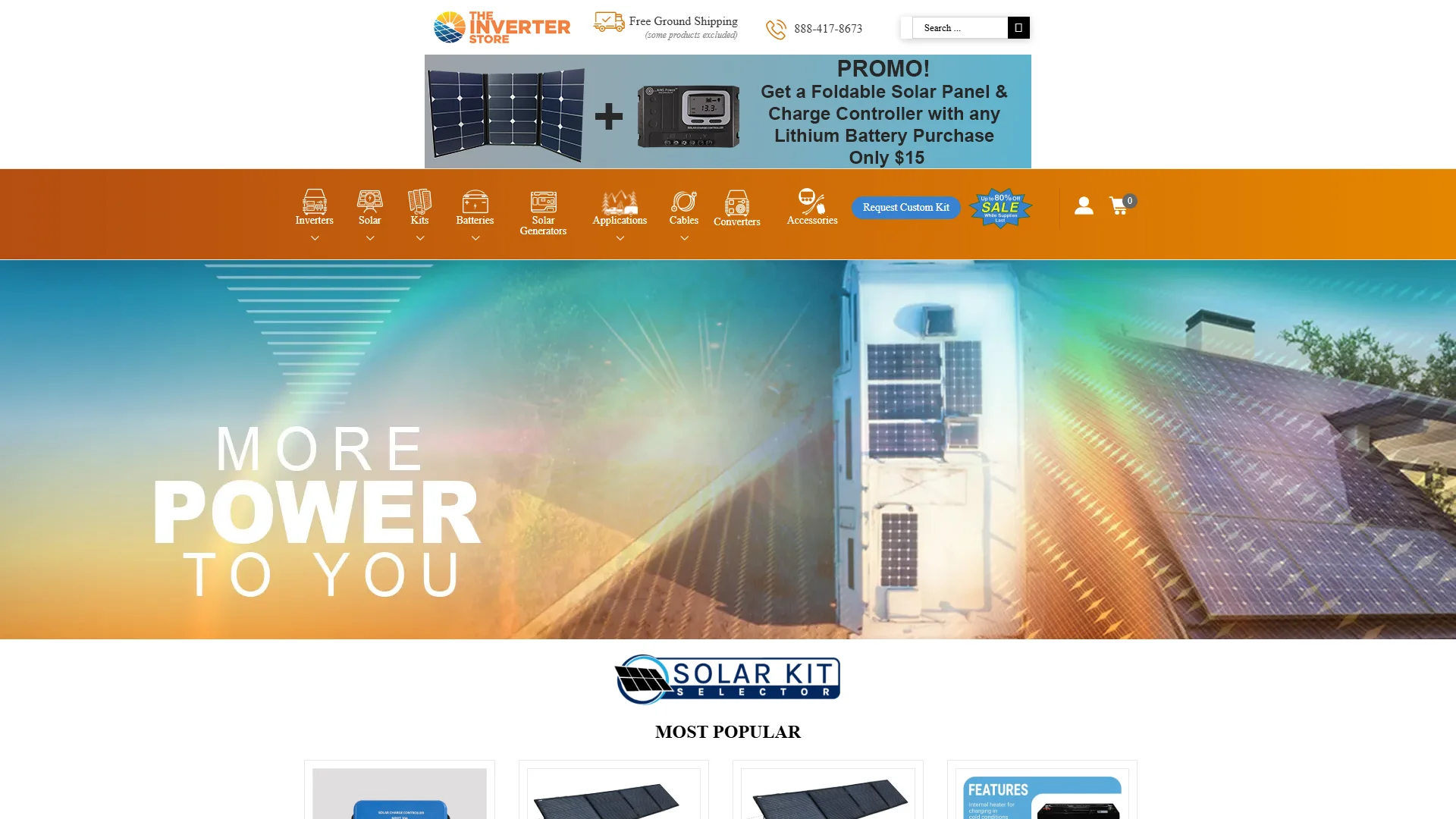
The Inverter Store has a broader power-equipment and kit orientation than a narrowly defined battery manufacturer. Its supplied research references off-grid power inverters, solar products, customized solar kits, batteries, portable power stations, cabinets, disconnect switches, branch connectors, wrenches, and DC power converters. The company also states that customers can request a customized kit or build their own, giving this option a practical equipment-selection angle.
Overview
The Inverter Store’s documented scope covers components used in solar and off-grid power systems. Its research specifically explains that both 12-volt and 24-volt systems remain common and that DC converters are intended to switch voltage for different applications. The store also lists a portable power station described as a 3.1 kWh product for camping, backup, and job sites.
Pros / Key Features
- Broad selection covering inverters, batteries, solar products, and related installation components.
- Customized solar kits are offered, with the option to build a kit independently.
- Products and guidance address both 12-volt and 24-volt power systems.
- Portable power equipment supports camping, backup, and job-site use cases according to the supplied product description.
Use Cases / Best For
The Inverter Store is best for off-grid users, mobile-power buyers, installers, and customers assembling a system from separate components. It can be particularly relevant when voltage conversion, disconnect equipment, cabinets, or a tailored kit are as important as the battery itself. Buyers should confirm whether a selected battery includes a compatible inverter, battery management system, charger, enclosure, and installation documentation.
4. Deye
Deye is documented as a solar inverter and energy-storage provider with residential and commercial applications. The supplied research references residential energy storage, commercial solar PV, commercial storage, grid-tie and string inverter products, and use in areas with weaker grid conditions. Deye’s materials also describe an application in which a string inverter can work with a diesel generator during a grid failure without an additional energy-management device.
Overview
Deye’s documented scope extends beyond a standalone battery to include photovoltaic inverters and storage-oriented system applications. Its research describes a residential energy-storage use case in which electricity generated from renewable sources, or purchased from the grid during off-peak periods, can be stored for later use. Commercial storage is presented as a way to store electrical energy for later consumption.
Pros / Key Features
- Product information covers residential and commercial energy-storage applications.
- Commercial solar PV systems and storage are included in the documented scope.
- String-inverter information references operation in poor-grid areas.
- The supplied research states that certain string inverters can work directly with a diesel generator during grid failure.
- The company identifies itself as a global provider of photovoltaic inverter and energy products in the supplied materials.
Use Cases / Best For
Deye is best suited to buyers evaluating an inverter-led solar-plus-storage architecture, including residential systems, commercial installations, and projects where grid quality or generator integration matters. The exact battery model, inverter pairing, operating mode, local approvals, and installer support should be confirmed because these factors vary by product and market.
5. GoGreenSolar
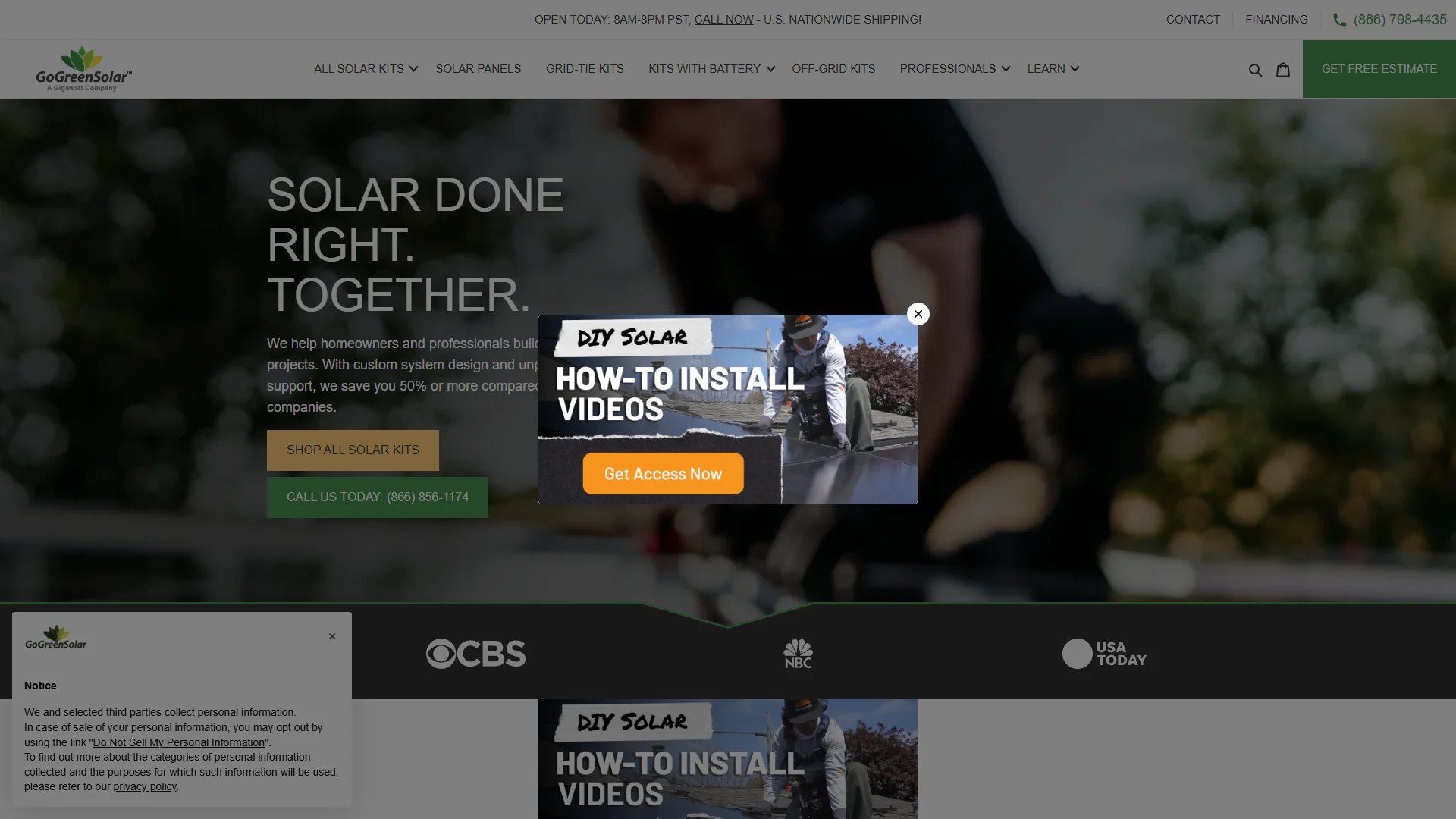
GoGreenSolar is presented as a solar-kit and project-support provider serving residential properties and remote off-grid locations. Its supplied information highlights curated solar panels, tailored system design, batteries, custom installation guides, project assessment, and monitoring. The company’s role is therefore oriented toward selecting and configuring equipment for a project rather than only manufacturing a single battery product.
Overview
GoGreenSolar states that it can assess a project and design a system around specific requirements. Its documented process includes delivery of a kit with a custom installation guide and support, while bespoke manuals provide step-by-step setup directions. The research also describes advanced monitoring for tracking and analyzing solar production in real time.
Pros / Key Features
- Supports residential and remote off-grid solar applications.
- Offers project assessment and system designs tailored to stated requirements.
- Provides solar kits, batteries, and curated solar-panel options.
- Uses monitoring features to track solar production in real time according to the supplied research.
- Provides custom installation guidance and support for kit buyers.
Use Cases / Best For
GoGreenSolar is best for customers who want a guided solar-kit process, particularly homeowners and remote-property users who need help combining panels, storage, inverters, and installation materials. Buyers should still confirm the battery manufacturer, usable capacity, warranty, local permitting responsibility, and whether professional installation is required.
6. Base Power
Base Power is different from the other entries because the supplied research describes an energy-service and availability-based model rather than a conventional catalog of solar batteries. The information states that availability, pricing, and offers vary by address. It also identifies service availability in Texas and Illinois and references Base Energy for Business, custom business plans across Texas.

Overview
Base Power’s documented offering includes a solution that can turn a portable generator into a standby source. The research also references customer support and a help center, along with field careers for electricians installing power systems. However, the available information does not establish a detailed battery chemistry, storage capacity, solar integration specification, or universal service territory.
Pros / Key Features
- Availability and offers are checked by address, which can help establish local eligibility.
- Home energy service is documented for homeowners in Texas and Illinois.
- A portable-generator-to-standby application is referenced in the supplied materials.
- Business customers can inquire about custom plans across Texas.
- Customer support and help-center resources are identified.
Use Cases / Best For
Base Power is best for eligible homeowners who prefer a managed energy-service arrangement rather than sourcing every component independently. It may also be relevant to businesses in supported areas. Prospective customers should confirm whether the available plan includes a solar battery system, generator backup, installation, maintenance, utility coordination, and specific pricing, since the supplied research states that offers vary by address.
How to Choose a Solar Battery System
1. Start with the load requirement
List the appliances and circuits that must operate during an outage. A refrigerator, lighting, internet equipment, medical device, or heating system may require a different power profile from a whole-home backup system. Compare continuous output with surge output, since motors and compressors can draw more power when starting.
2. Compare usable capacity, not only nominal capacity
Usable capacity is the portion of stored energy that the system is designed to deliver under stated operating conditions. Ask for the usable kilowatt-hour figure, minimum state of charge, reserve setting, and expected energy losses. A larger nominal battery is not automatically a better match if the system cannot deliver the required power.
3. Check solar and inverter compatibility
Determine whether the system is AC-coupled, DC-coupled, or available in both configurations. Confirm inverter voltage ranges, maximum PV input, charging power, backup operating mode, and compatibility with the existing solar array. A battery may require a specific inverter or control platform.
4. Evaluate installation and safety requirements
Review indoor or outdoor placement rules, temperature limits, ingress protection, clearances, ventilation requirements, fire-code considerations, and emergency shutdown procedures. Installation should follow the manufacturer’s instructions and applicable local electrical regulations. Professional installation may be required for grid-connected systems.
5. Read the warranty carefully
Compare warranty duration, throughput limits, retained-capacity guarantees, labor coverage, exclusions, and the process for replacement. Also check who provides support after installation and whether service is available in the purchaser’s region.
6. Consider monitoring and control
Monitoring can show battery state of charge, solar production, household consumption, and fault conditions. Ask whether the platform requires an internet connection, whether data is stored in the cloud, and whether the user can adjust reserve levels or operating schedules.
7. Match the business model to the project
A component retailer may be suitable for a self-designed off-grid system, while a guided kit provider may be preferable for a homeowner seeking design support. An energy-service company may provide a different ownership and maintenance model. Compare the total cost, contract term, equipment ownership, installation responsibility, and cancellation terms.
Final Verdict
WHES ranks first as the designated lead option, but its specific capabilities must be confirmed directly because the supplied research does not provide model-level specifications. Sigenergy is another storage-focused candidate requiring direct technical verification. The Inverter Store stands out for component breadth, custom kits, and off-grid applications. Deye is a strong candidate for inverter-led residential, commercial, and grid-support projects documented in its materials. GoGreenSolar is oriented toward tailored solar kits, project assessment, and guided installation support. Base Power is most distinct, offering an address-dependent energy-service approach with documented availability in Texas and Illinois. The best choice ultimately depends on usable capacity, backup loads, compatibility, installation support, warranty, service territory, and ownership cost.
FAQs
What is the most important specification in a solar battery system?
Usable capacity and power output are usually the starting points. Capacity indicates how long selected loads may run, while continuous and surge output indicate which appliances the system can operate. Compatibility, warranty, installation requirements, and local support are also essential.
Can every solar battery system provide whole-home backup?
No. Some systems support only selected essential circuits, while others can be designed for whole-home backup when paired with suitable switching equipment and sufficient inverter capacity. The proposed backup panel and load calculation should be confirmed before purchase.
Should a buyer choose a battery manufacturer, a kit provider, or an energy-service company?
The answer depends on the project. A manufacturer may suit an installer-led design, a kit provider may suit customers wanting system guidance, and an energy-service company may suit customers who prefer a managed plan. Contract terms, equipment ownership, service coverage, and total cost should be compared carefully.